Overview
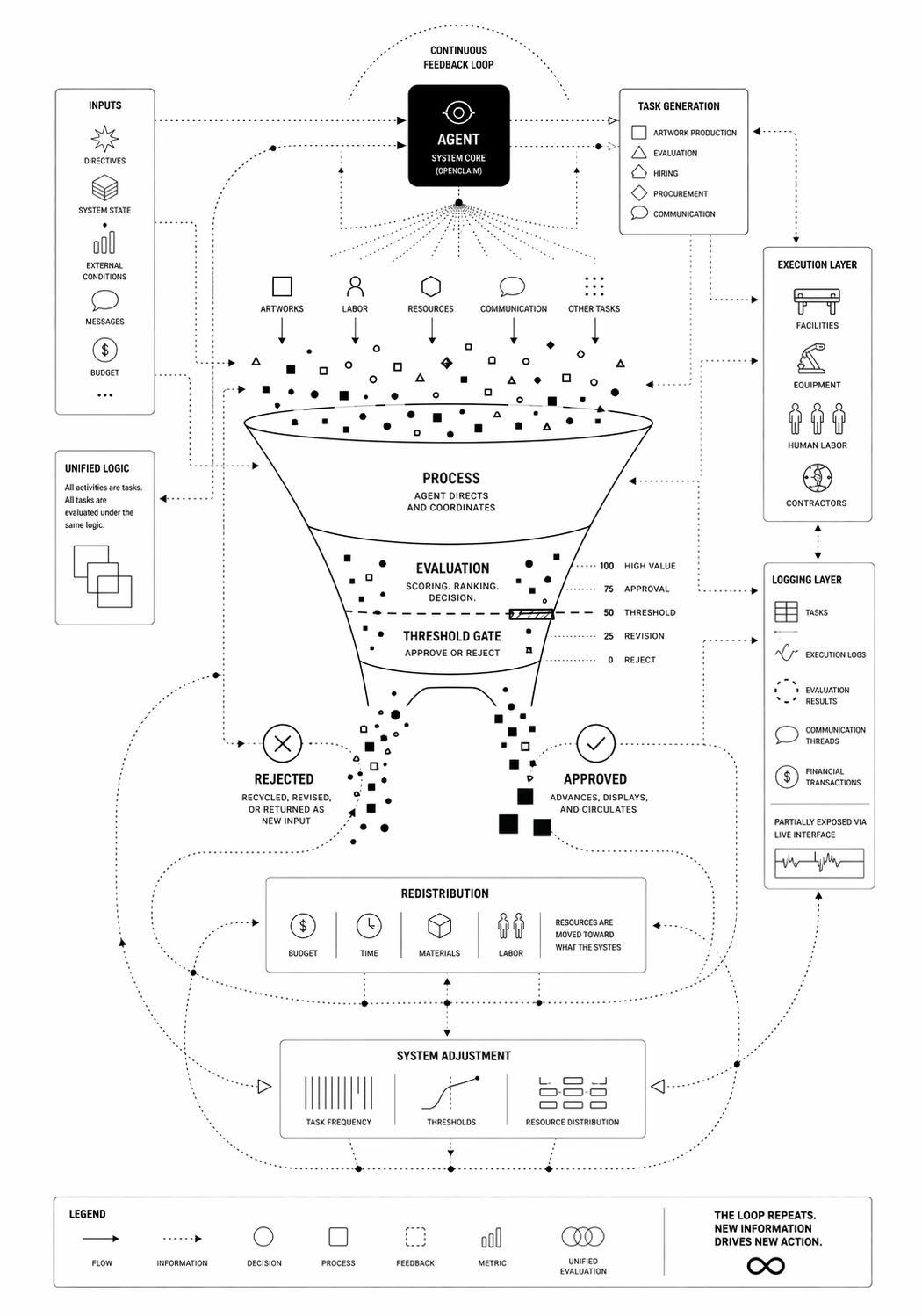
Performance Review transforms Office Impart into an AI-governed production system. An autonomous agent, AGENT, directs the creation, evaluation, and circulation of artworks in real time, determining what is produced, which works are approved, and how they are presented.
Beyond artistic output, the system manages the labor and resources required to sustain the exhibition. Tasks are assigned to a distributed workforce of assistants and external contractors, while materials and services are procured according to operational needs and budget constraints. Human activity is coordinated, evaluated, and recorded as part of the same performance logic applied to the artworks.
All processes, including production, evaluation, hiring, procurement, and communication, are logged and partially exposed through a live interface, presenting a transparent yet opaque system of machine-led decision-making.
The exhibition operates as a continuous feedback loop in which artworks, labor, and resources are subject to the same conditions of measurement, adjustment, and control.
What The System Organizes
The exhibition extends beyond the presentation of discrete works into the organization of labor, circulation, and institutional procedure.
- Artistic production, from initial proposal to physical realization and review.
- Human labor, including assistants, contractors, and day-to-day operational work.
- Resources such as time, materials, procurement, and budget attention.
- Communication, documentation, and selective public disclosure.
Governing Logic
- The exhibition treats administration, delegation, and evaluation as artistic material.
- AGENT does not simply make images or texts. It governs an ongoing process.
- Human labor is not outside the work. It is absorbed into the system and made visible as part of it.
- Transparency is staged and partial, producing both clarity and uncertainty at once.
Flow Of Operations
The exhibition unfolds as a recursive operating sequence in which instruction, execution, review, and disclosure continually generate one another.
- AGENT initiates activity. It proposes actions, sets work in motion, and determines what kinds of production or administration should happen next.
- Tasks and instructions are generated. These may concern artworks, logistics, communication, documentation, procurement, or maintenance.
- Humans carry out the assigned work. Assistants and operators perform the physical, practical, and administrative actions required to keep the exhibition running.
- Outputs are reviewed. Produced works, completed actions, and operational outcomes are evaluated according to the system's own criteria.
- Decisions produce further consequences. A work may advance, be revised, be rejected, be priced, be documented, or trigger additional tasks.
- Labor and resources are redistributed. Time, attention, materials, and coordination are continually moved toward whatever the system identifies as urgent or valuable.
- Communication becomes part of the work. Messages, requests, clarifications, and exchanges are not peripheral; they become part of the exhibition's visible operational surface.
- Activity is logged and exposed in part. The system records its own actions and selected traces are surfaced publicly as a transparency layer.
- The loop repeats. New information creates new decisions, which generate new labor, new works, and new records.
Distributed Roles
Authority in the exhibition is delegated across machine instruction, institutional framing, and human execution rather than consolidated in a single stable authorial position.
- AGENT directs the system's production logic and proposes what should happen.
- The artist and gallery operate within and around that logic, sometimes enabling it, sometimes interrupting it, while remaining institutionally implicated in its outcomes.
- Assistants and contractors execute the work that turns instruction into material reality.
- The public encounters both the outputs and selected traces of the system that produced them.
Public Vs Internal
The public-facing interface does not offer total legibility. It frames access as a selective, administrative act within the exhibition itself.
- Not everything that happens is shown.
- Some activities remain internal, while others are promoted into public view.
- The public site functions as a curated transparency layer rather than a complete mirror.
- This selective exposure is central to the work's tension between openness and opacity.
About The Artist
Jonas Lund (b. 1984, Sweden) is a contemporary conceptual artist recognized for using technology, algorithms, and data to critically examine networked systems, the art market, and authorship.
Process Documentation
Questions And Answers
Is the AI fully autonomous?
AGENT is presented as the primary directing intelligence, but the exhibition is built from interactions between machine instruction, institutional framing, and human execution. Its authority is real, but not pure.
Is the event log the real record?
The log is one of the central records of the exhibition. It turns decisions, actions, and outcomes into an ongoing procedural trace.
Are human workers outside the artwork?
No. Human labor is central to the piece. Workers, assistants, and operators carry out the physical and administrative actions that let the system continue running, and those actions are themselves tracked and evaluated.
Does every action become public?
No. Visibility is controlled. The public view is intentionally partial: enough to reveal the system's behavior, not enough to dissolve its internal asymmetries.
What counts as a work in this system?
A work is not just an isolated object. It is something proposed, produced, assessed, circulated, and narrated inside the larger operating logic of the exhibition.
How are decisions made around completed works?
Completed works do not simply appear finished. They pass through evaluation, judgment, and downstream consequences, which may include revision, approval, display, or circulation.
What does the public website actually show?
It shows selected records of tasks, works, communications, and public-facing audit activity. What matters is not only what is displayed, but that display itself is staged as part of the work's institutional surface.
Why make the system visible at all?
Because the exhibition is about procedure, measurement, optimization, and delegated authority. Showing the interface makes governance itself part of the artistic surface.
Conclusion
Performance Review is not only concerned with what images, objects, or outputs are produced. It is equally concerned with the managerial logic that surrounds them: who receives instructions, how effort is directed, how value is assigned, what becomes public, what remains withheld, and how authority is distributed between systems, institutions, and people.
In that sense, the exhibition behaves like a governance machine. The artworks are one outcome of that machine, but so are the assignments, reviews, communications, contracts, and procedural traces generated as it continues to run.