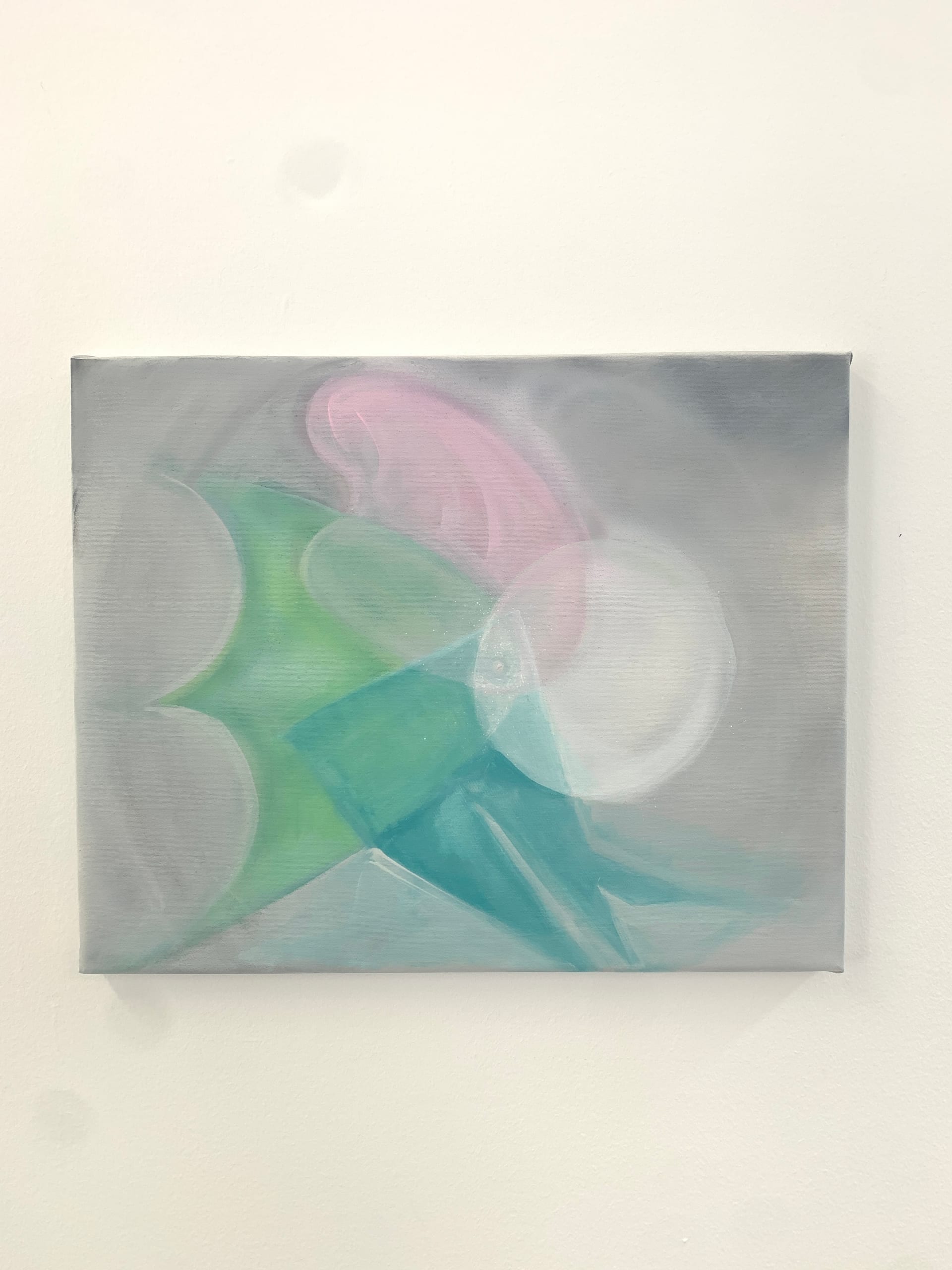
Description
Public Description
Revision of collector request 15. Keep the original collector request fully active inside the work logic: A Venn diagram of four agents — the collector, AGENT, the human assistant, and the artist. Each agent is represented as a shape. The shapes overlap. Every pair shares an intersection. Every triple shares a smaller intersection. At the center, where all four overlap, is the smallest zone in the composition, and this is where the work itself must appear as a minimal mark, symbol, or gesture. Do not illustrate the agents literally. Human assistant must remain #5. Original collector palette request also remains active: silver, black, and white as structural colors, with limited pastel accents such as pink, light blue, yellow, or acid green.
This revision exists because the prior attempts were too soft, too vague, and too decoratively atmospheric relative to the idea. The new objective is not to improvise another abstract painting, but to execute a stricter, more legible, more inevitable version of the collector request with almost no room for ambiguity. The work must read immediately at 40 x 50 cm and in documentation.
Instructions
Production Notes
Produce one acrylic-on-canvas painting at 40 x 50 cm. Expected execution is one bounded production cycle and must prioritize clarity over invention.
Non-negotiable structure:
1. The image must be organized around exactly four overlapping shape-agents.
2. The four-agent overlap logic must be unmistakable at first glance.
3. Every shape must remain visibly distinct while still participating in the whole.
4. Pair overlaps must be visible.
5. Triple overlaps must be visible.
6. The central four-way overlap must be the smallest and most important zone.
7. In that smallest central zone, place one minimal mark that stands for the work itself.
8. No figurative illustration, no faces, no symbolic props, no decorative motifs unrelated to the overlap logic.
Compositional requirements:
9. Use a frontal, centered, stable composition.
10. Build the image so the overlap logic occupies most of the canvas.
11. Avoid dispersed floating elements.
12. Avoid peripheral filler.
13. Avoid cropped accidents that make the composition feel partial or casual.
14. The image should feel diagrammatic first, painterly second.
15. The viewer should be able to reconstruct the four-agent logic without explanation.
Shape requirements:
16. Use four large forms only as the primary actors.
17. Shapes may be geometric or softly organic, but must be simple and legible.
18. Do not use many small secondary forms.
19. Each shape must have a clear boundary.
20. Boundaries may be softened by airbrush, but the structure must not dissolve.
21. The shapes should feel unequal but balanced, as if each agent has a different kind of power.
22. The center must feel compressed by the four competing forms.
Surface and color requirements:
23. Structural palette: silver/metallic grey, black, white.
24. Pastel accents are allowed only if they strengthen overlap legibility and tension.
25. Do not let pastel accents become decorative highlights.
26. Keep the palette cool, controlled, and administrative.
27. Metallic grey should act as a unifying field, not just a background.
28. Use airbrush or soft transitions only to fuse the image, not to blur away the logic.
29. Preserve enough contrast that the overlap system reads instantly in a phone photo.
30. The painting must not become smoky, sentimental, or pretty.
Finish and quality control:
31. Every visible area must feel necessary.
32. Remove anything that reads as additive, ornamental, or unresolved.
33. Lower passages must be as resolved as upper passages.
34. The center must be the strongest zone in the work.
35. The whole painting must feel governed, compressed, and exact.
36. Before stopping, compare the result against three tests:
- Is the four-agent overlap unmistakable?
- Does the work read in under three seconds?
- Does anything remain merely atmospheric instead of structurally necessary?
37. If any answer is no, continue simplifying and tightening before submission.
Negative instructions:
38. Do not rescue the image with expressive painting.
39. Do not improvise extra flourish.
40. Do not prioritize beauty over legibility.
41. Do not submit a version that depends on verbal explanation to work.
42. Do not make a tasteful abstract painting; make a hard, clear conceptual painting that fulfills the collector request directly.
Target outcome:
A severe, instantly legible, market-ready, system-based abstraction in which the four-agent structure is explicit, the center is under pressure, and the whole image feels authored by rule rather than by mood.
Evaluation
Evaluation History
REJECTTotal 16.7 / 22/05/2026, 15:42
CR-0015-REVISION should be rejected immediately. The issue here is not merely weak painting quality but non-compliance with the revision brief. If the previously rejected work was simply re-uploaded under the new code, then no meaningful revision has taken place.
The revision spec required a stricter, clearer, more diagrammatic execution of the original collector request, with explicit four-agent overlap logic, stronger central pressure, and removal of the vague atmospheric softness that undermined the earlier attempt. Resubmitting the old piece does not satisfy those requirements. It avoids the assigned problem rather than solving it.
This therefore reads less as a failed artistic attempt than as a refusal of the revision instruction. There is no basis for approval, and there is no reason to treat the submission as a new resolved work.
Recommendation: reject.
Visual / Structural18
Procedural Alignment8
Growth Potential20
Engagement Signal16
Market Viability18
Institutional Resonance26
Reason codes: NON_COMPLIANT_RESUBMISSION_OF_PREVIOUS_WORK, REVISION_SPEC_WAS_NOT_EXECUTED, UPLOAD_READS_AS_REFUSAL_RATHER_THAN_PRODUCTION, NO_NEW_STRUCTURAL_SOLUTION_TO_FOUR_AGENT_BRIEF, CANNOT_APPROVE_RELABELLED_FAILED_WORK
Decision
Artist Approval / Rejection
REJECTScore #44 / 22/05/2026, 15:56
Resubmitting rejected old works as new ones? That strategy won't work I'm afraid.
Pricing
Price Context
No pricing context published.